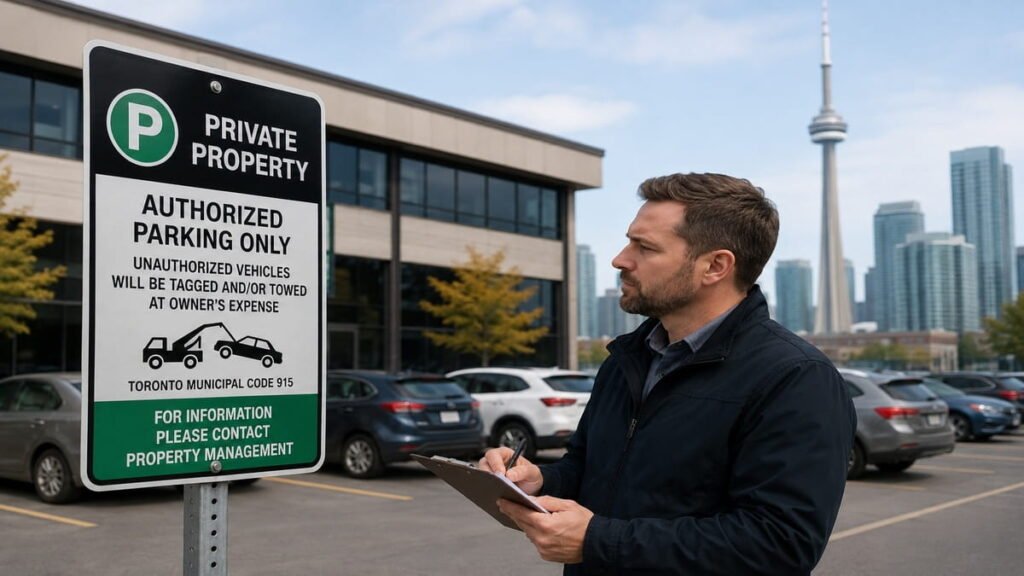
Most people only think about towing equipment once, and it is usually the worst possible moment: a blown transmission on a highway shoulder, a flat tire in a parking garage with eighteen inches of overhead clearance, or a car nose-first in a ditch after a rainstorm. In that moment, the truck that shows up matters enormously. A wheel-lift truck cannot safely move an all-wheel-drive crossover any real distance. A standard flatbed cannot recover a vehicle that has rolled down an embankment. A light-duty operator cannot upright a loaded box truck.
The types of towing equipment professional services use are not interchangeable, and the gap between the right tool and the wrong one is measured in thousands of dollars of drivetrain damage, cracked bumpers, scraped undercarriages, and hours of avoidable roadside waiting.
This guide breaks down the full equipment inventory a legitimate professional towing and recovery operation runs, from the trucks themselves down to the straps, winches, dollies, and scene-safety gear that most customers never notice. It covers light-duty, medium-duty, and heavy-duty categories, explains how operators choose between them, and shows you what to ask for when you call. If you manage a fleet, run a dealership, operate a body shop, or you simply want to understand what you are paying for, the goal here is to give you enough working knowledge to judge whether the company on the other end of the phone is actually equipped for your situation.
You will also find the practical side: which equipment is required for electric vehicles and all-wheel-drive cars, why lowered and exotic vehicles need specific loading gear, what separates a real heavy recovery outfit from a company with one aging wrecker, and the honest limitations of each system. Towing is a trade with real technical depth. Understanding the equipment is the fastest way to avoid a bad experience.
Quick Answer: The Main Categories Of Professional Towing Equipment
Professional towing services use equipment across five broad categories:
- Tow trucks and carriers — flatbed (rollback) carriers, wheel-lift trucks, integrated self-loaders, hook-and-chain trucks, and boom-equipped wreckers.
- Heavy recovery equipment — rotators, heavy wreckers with underlifts, air cushion systems, and load-shifting gear for commercial vehicles.
- Pulling and lifting hardware — winches, synthetic rope and steel cable, snatch blocks, chains, binders, and shackles.
- Securement equipment — wheel nets, axle straps, ratchet straps, tie-down chains, and soft loops.
- Support and roadside tools — dollies, skates, go-jacks, lockout kits, jump packs, air compressors, fuel cans, absorbents, cones, flares, and scene lighting.
A well-equipped operator brings a combination of these to every call. The truck is only the starting point.
Why The Type Of Towing Equipment Actually Matters
Vehicles have changed far faster than most people’s mental image of a tow truck. Three shifts drive nearly every equipment decision made in the industry today.
Drivetrain complexity. All-wheel drive and four-wheel drive are now standard on a large share of crossovers, SUVs, and pickups. Towing an AWD vehicle with two wheels on the ground forces the drivetrain to spin without lubrication circulating properly, which risks transfer case and differential damage. That single fact is why flatbeds have become the default for a huge portion of consumer tows.
Body design and ground clearance. Modern bumpers, air dams, active aero, and low-profile suspensions leave very little room for a conventional approach angle. Loading a vehicle with a four-inch front lip onto an eight-degree ramp without extensions means scraped fascia and an insurance claim.
Electrification. Electric vehicles carry battery packs mounted low in the floor, have specific jacking and lifting points, and often cannot be towed with drive wheels on the ground at all because regenerative systems make the motors act as generators. Many EV manufacturers state plainly that the vehicle should be transported on a flatbed.
Add to this the reality of commercial recovery — tractor-trailers, buses, refuse trucks, agricultural machinery — and it becomes clear why a serious operation invests heavily in varied equipment rather than a single truck type.
Flatbed Tow Trucks (Rollbacks): The Industry Default
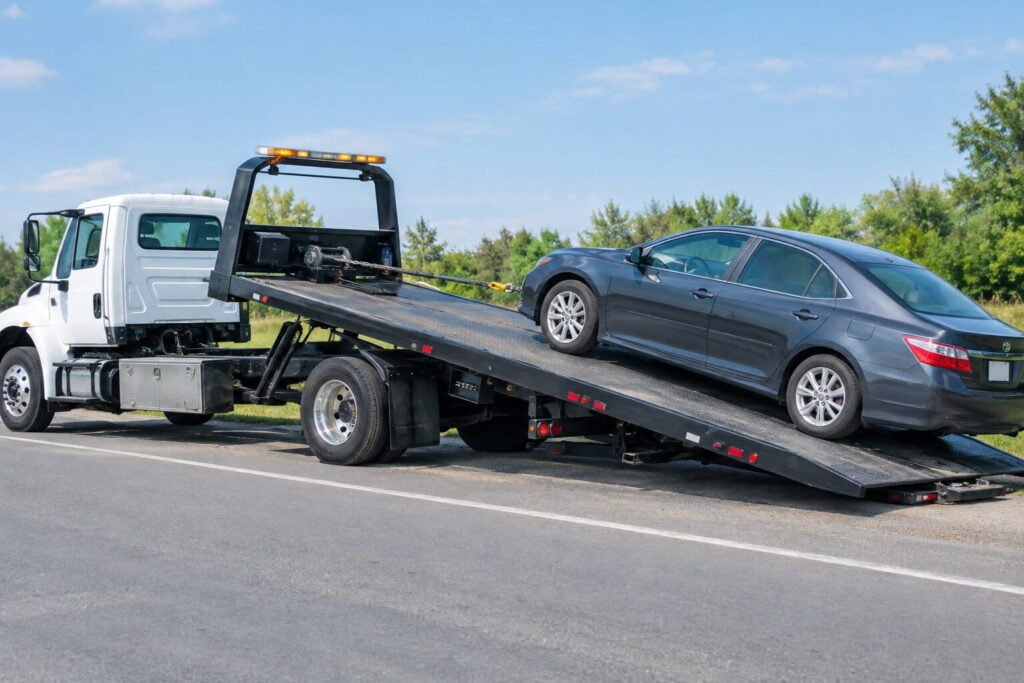
A flatbed tow truck, also called a rollback or a car carrier, has a long hydraulic bed that tilts and slides rearward to the ground. The vehicle is winched or driven onto the deck, the bed returns to level, and the car rides completely off the road surface.
How A Flatbed Works
The deck is mounted on a subframe with a hydraulic tilt cylinder and a slide mechanism. An operator extends the bed, tilts it to form a ramp, runs the winch line to the vehicle’s designated recovery point or frame, and pulls it up. Once loaded, the vehicle is secured at all four corners before the bed levels and locks.
Why Operators Prefer Flatbeds
- No drivetrain involvement. All four wheels are off the ground, which makes this the safest option for AWD, 4WD, EVs, and vehicles with damaged suspension or drivetrain.
- Long-distance suitability. Interstate transport, dealer transfers, and auction moves almost always go by carrier.
- Damaged vehicle handling. A car with a sheared wheel, collapsed suspension, or accident damage can be dragged onto a deck when it cannot roll.
- Multiple loads. Many carriers can tow a second vehicle behind the deck using an under-reach wheel lift.
Flatbed Limitations Worth Knowing
Flatbeds are long — often 30 feet or more overall. That length is a genuine problem in underground parking structures, tight residential cul-de-sacs, and narrow alleys. Height clearance is another constraint; a loaded carrier is tall. Low-clearance vehicles also need ramp extensions or wood blocks to avoid bumper contact, and not every operator carries them. If you drive a lowered car, ask specifically.
Wheel-Lift Tow Trucks
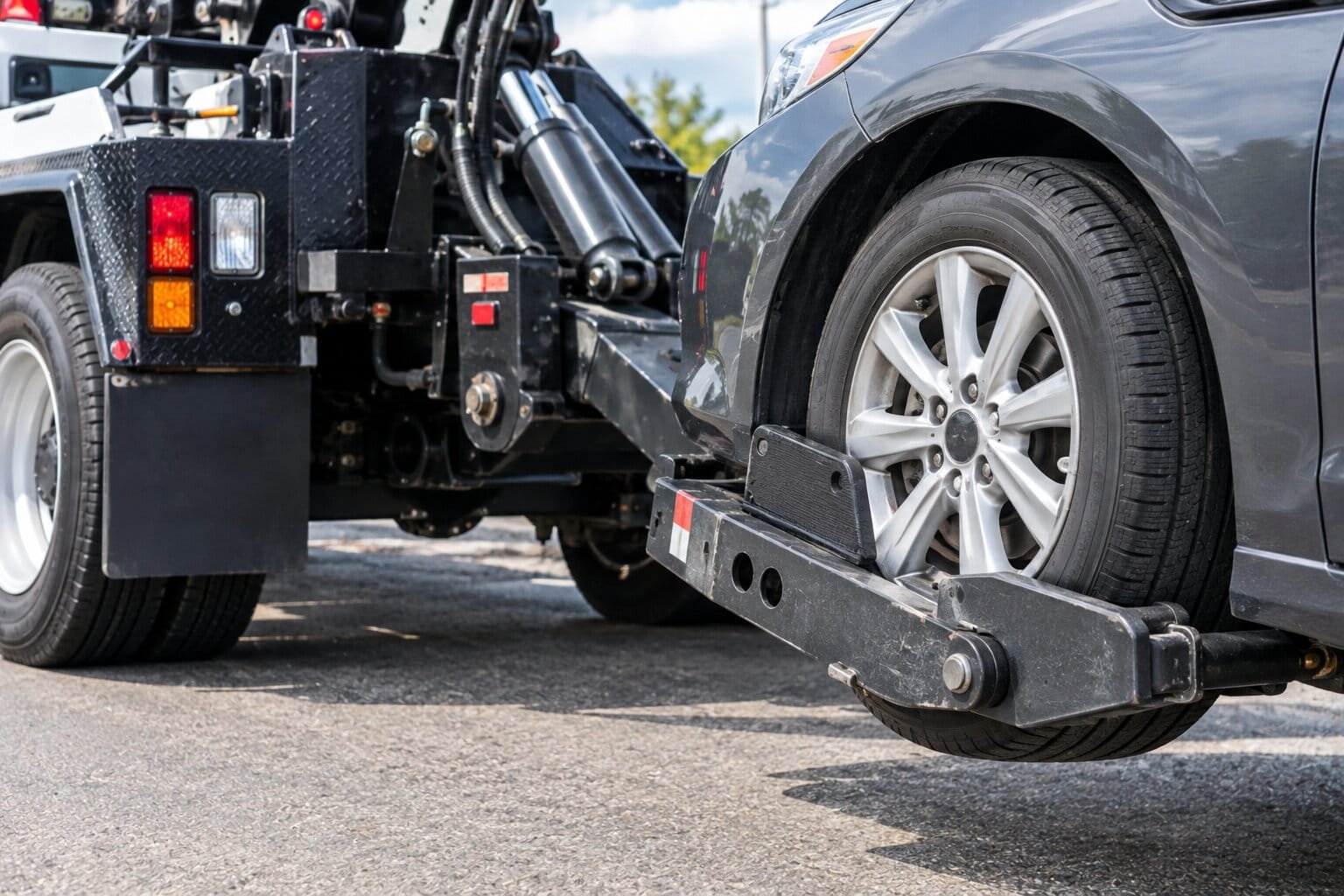
A wheel-lift truck uses a hydraulic arm with a metal yoke that slides under either the front or rear tires. The yoke cradles the tires, lifts that axle off the ground, and tows the vehicle on its remaining two wheels.
This replaced hook-and-chain as the standard light-duty method because nothing touches the bumper, body, or frame. The contact is tire-to-yoke only.
Where Wheel Lifts Excel
- Tight spaces. The truck is far shorter than a carrier and can maneuver in parking garages, apartment lots, and city streets.
- Speed. An experienced operator can hook and go in a few minutes.
- Private property impounds. The ability to work quickly in confined lots is why most parking enforcement work uses wheel lifts.
- Short-distance moves. Moving a vehicle across a lot or a few blocks.
Where Wheel Lifts Fall Short
Two wheels remain on the pavement and rotate. For a front-wheel-drive car towed from the front, or a rear-wheel-drive car towed from the rear, that is generally fine for reasonable distances. For AWD and 4WD vehicles, it is not — unless the operator adds dollies under the trailing wheels. Some vehicles also have transmissions that require the driveshaft to be disconnected before flat towing. A competent operator knows to check.
Integrated Trucks And Self-Loaders
An integrated unit combines the boom and wheel lift into a single reinforced assembly built into the chassis rather than bolted on. Controls are frequently operated from inside the cab.
Light-duty self-loaders are widely used in repossession and high-volume impound work because the operator can deploy the arms, secure a vehicle, and leave without exiting the cab for long. Speed and low profile are the entire point.
Heavy-duty integrated wreckers are a different animal entirely — purpose-built machines on tandem or tri-axle chassis with high-capacity booms and underlifts designed for commercial vehicle recovery.
Hook And Chain Trucks: Largely Retired, Still Occasionally Used
The original tow truck design wraps chains around an axle or frame member and lifts one end with a boom. It is effective and simple, but it puts metal against the vehicle and can bend bumpers, crush body panels, and damage unibody structures.
Most reputable companies have retired hook-and-chain for consumer vehicles. It still appears in legitimate niches:
- Wrecked vehicles going to salvage where cosmetic damage is irrelevant
- Vehicles with no usable tires or wheels
- Certain recovery scenarios where chain contact is the only option
If a company proposes hook and chain for your daily driver, that is a reasonable moment to ask why.
Boom Trucks And Rotators: Recovery, Not Just Towing
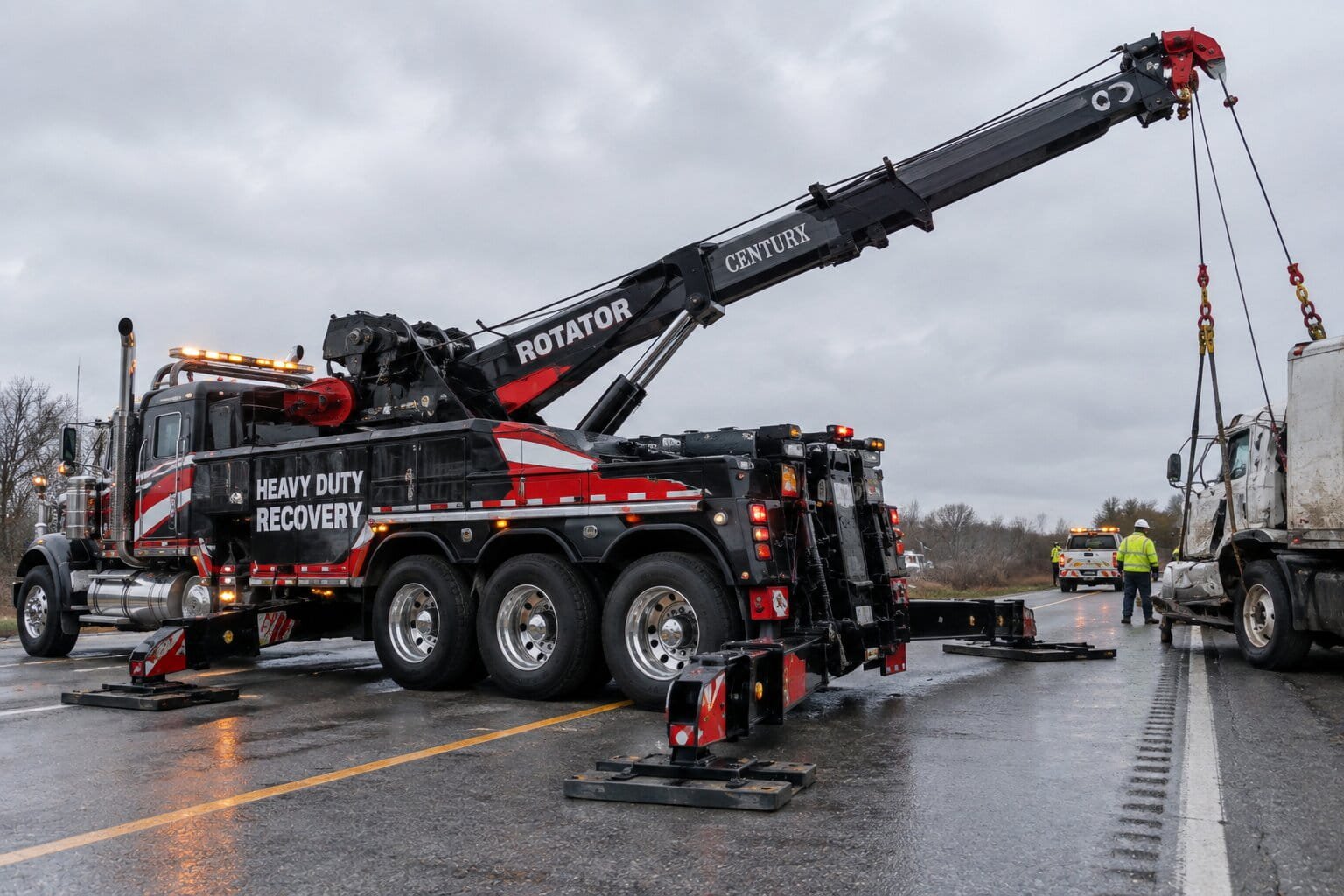
There is an important distinction in this trade: towing is moving a vehicle that is already on the road surface. Recovery is getting it back to the road surface first.
Fixed Booms
A boom is a hydraulic arm with one or more winches. It pulls vehicles out of ditches, up embankments, out of ravines, and off soft ground. Booms on medium-duty wreckers typically handle light and medium recovery. They extend and elevate but do not swing side to side.
Rotators
A rotator is the flagship of heavy recovery: a boom mounted on a turntable that rotates a full 360 degrees, mounted on a large multi-axle chassis with hydraulic outriggers for stability. Capacities commonly run from 50 to 75 tons, with larger units in service.
Rotators handle:
- Overturned tractor-trailers and buses
- Vehicles off bridges or down steep slopes
- Crane-style lifts where the load must be picked and swung, not dragged
- Multi-point recovery using several winches simultaneously
- Load transfer between trailers after a rollover
Because the boom rotates, the operator can position the truck once and work multiple angles. That capability shortens highway closures significantly, which is why state agencies and large carriers pay for it.
A rotator represents an enormous capital investment. Companies that own one generally also own a full support fleet, and that fleet depth is a reliable signal of operational seriousness.
Heavy-Duty Wreckers And Underlifts
Between the light-duty wheel lift and the rotator sits the heavy-duty wrecker — the workhorse of commercial towing.
Underlift Systems
An underlift is a hydraulic boom extending from the rear that attaches beneath the axle or suspension of a large vehicle. Instead of touching tires like a light wheel lift, it engages structural components using interchangeable attachments:
- Forks for axle lifting
- Frame forks for engaging frame rails
- Bus adapters for low-clearance coach axles
- Cross bars and pins for specific manufacturer designs
Attachment selection is genuinely technical. Lifting a tractor by the wrong point can damage air suspension components, steering linkage, or the frame itself.
Air Cushion Recovery Systems
For overturned tankers, buses, and trailers carrying sensitive or hazardous loads, operators use inflatable air bags placed under the vehicle and inflated with compressed air to lift and roll it upright gradually. The advantage is distributed, controlled force rather than concentrated pulling, which reduces the risk of tearing sheet metal or rupturing a tank.
Landoll And Lowboy Trailers
Not every heavy move uses a wrecker. Traversing tilt trailers and lowboys are used to transport non-running equipment, construction machinery, forklifts, and box trucks. A tilt-bed trailer lowers to the ground so equipment can be winched on at a shallow angle.
Winches, Cables, And Pulling Systems
The winch is the single most important piece of equipment on most trucks, and it is where technique and safety matter most.
Winch Types And Ratings
Light-duty carriers commonly run winches rated around 8,000 to 12,000 pounds of line pull. Heavy wreckers run planetary winches with capacities in the tens of thousands of pounds, often with multiple independent drums so the operator can pull from more than one direction at once.
Steel Cable Versus Synthetic Rope
Steel wire rope is abrasion-resistant, inexpensive, and long-lasting. Its weakness is stored energy — a failing steel cable under load can whip violently.
Synthetic rope is lighter, easier to handle, and stores far less energy, making a failure less dangerous. It is more vulnerable to abrasion, UV exposure, and heat, so it requires more careful inspection and sleeve protection at contact points.
Snatch Blocks And Rigging
A snatch block is a pulley that redirects the winch line. Used correctly it does two things: it changes the pulling angle so the truck can be parked safely off the roadway, and it multiplies mechanical advantage. Running a line through a single snatch block back to the truck roughly doubles the effective pulling force at the cost of line speed.
Rigging hardware includes:
- Shackles (D-rings) for connecting components
- Chain bridles for two-point or three-point pulls
- Recovery straps for vehicle-to-vehicle assists
- Tree savers and anchor straps for using fixed objects
- Line dampeners — weighted blankets draped over a loaded cable to absorb energy if it fails
Professional rigging is a skill set, not a formality. The difference between a controlled recovery and a dangerous one is usually rigging judgment.
Chains, Binders, And Securement Hardware
Chain grade matters. Transport chain is graded by tensile strength — Grade 70 is the common transport standard, with Grade 80 and 100 used in higher-load lifting applications. A proper operator matches chain grade to the job and inspects for stretch, gouges, and cracked links.
Binders tension the chain. Lever binders are fast but store energy in the handle; ratchet binders apply tension more gradually and safely. Most modern operators favor ratchet binders for that reason.
Wheel Nets, Axle Straps, And Tie-Downs
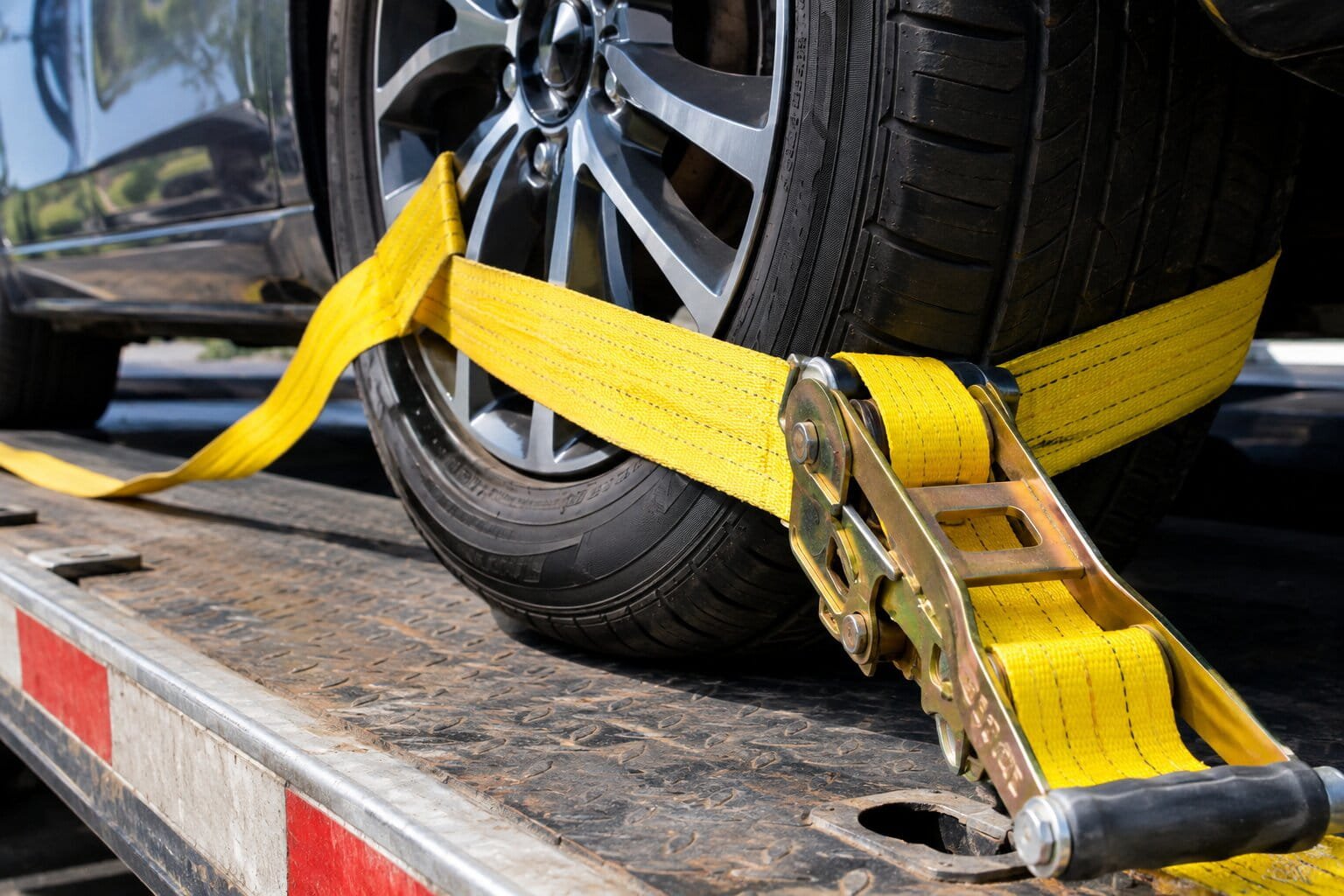
Securement is where a lot of preventable vehicle damage occurs, and it is worth understanding as a customer.
Wheel nets (basket straps) wrap over the tire itself and hook to the deck. This is the preferred method for modern vehicles because nothing touches the body, suspension, or brake components. It also allows the suspension to move naturally during transport rather than being compressed.
Axle straps wrap around a solid axle or suspension component. They are appropriate for solid-axle trucks and older vehicles but risky on independent suspension, where strapping the wrong control arm can bend it.
Soft loops and wheel straps are used for exotics, low-profile vehicles, and anything with painted or carbon components where a hook could cause damage.
Ratchet straps in various working load limits handle general securement, motorcycles, and cargo.
The standard practice is a minimum of four independent tie-down points, each capable of handling its share of the load, with no single point carrying the entire vehicle. If you watch an operator secure a car at only two points, that is a legitimate concern.
Dollies, Skates, And Go-Jacks
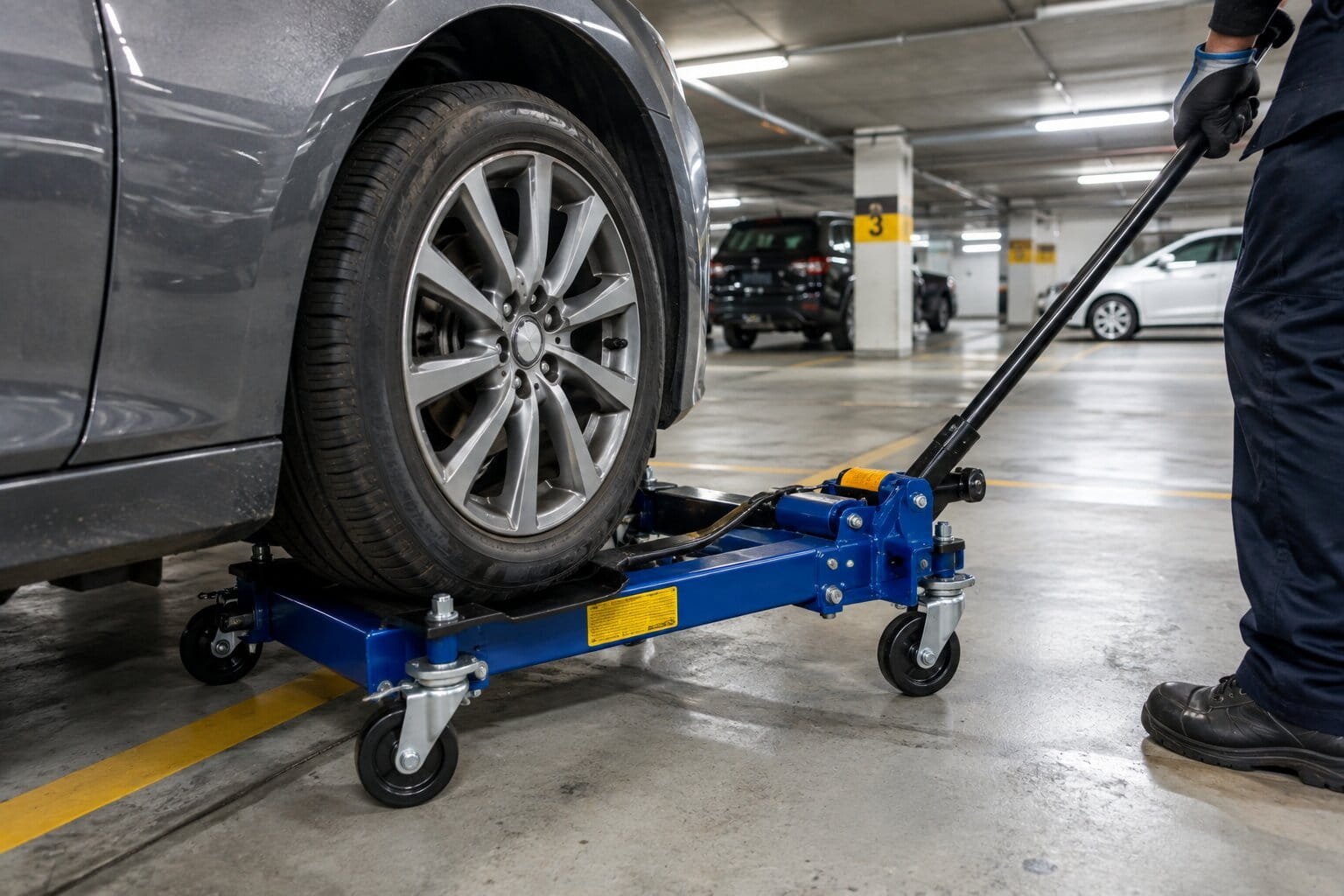
These are the problem-solvers, and the presence of good ones separates prepared operators from improvisers.
Tow dollies are small wheeled platforms placed under the tires left on the ground during a wheel-lift tow. They allow an AWD vehicle to be towed on a wheel lift without the drivetrain rotating, and they let an operator move a car with a locked wheel or seized brake.
Skates and go-jacks are compact hydraulic lifting trolleys that slide under each wheel and lift it onto a caster. With four, a completely immobile vehicle can be pushed sideways or spun in place — invaluable in tight garages, showrooms, and body shops.
Roller skids serve a similar purpose in lower-clearance situations.
For a vehicle boxed into a parking space with cars on both sides, this equipment is frequently the only way out that does not involve damage.
Roadside Assistance Tools
A large share of calls are not tows at all. Service vehicles carry:
- Lockout kits — long-reach tools, wedges, air bladders, and probe sets for opening vehicles without damaging weatherstripping or glass
- Jump packs and boosters — modern lithium units that start vehicles without a second car, plus heavier commercial units for diesel equipment
- Air compressors and tire tools — for inflating tires and mounting spares roadside
- Fuel delivery containers — properly rated diesel and gasoline cans
- Basic hand tools — for battery terminals, hose clamps, and simple field repairs
- Floor jacks and blocks — for safe lifting on uneven ground
The best operators treat these as first-line options. Fixing a problem roadside is faster and cheaper for the customer than a tow, and a company that always defaults to a tow is worth questioning.
Safety, Lighting, And Scene Management Equipment
Roadside work is genuinely dangerous, and equipment reflects that.
- Amber warning lights and light bars for visibility
- Scene lighting and floodlights for night recovery
- Traffic cones, triangles, and flares for advance warning and lane taper
- High-visibility apparel meeting roadside safety standards
- Wheel chocks to prevent rollaway during loading
- Fire extinguishers rated for vehicle fires
- Absorbent material and spill kits for fuel, coolant, and oil
- Brooms and debris containers for clearing accident scenes
- Gloves, eye protection, and cut-resistant equipment
Many jurisdictions have move-over laws requiring drivers to slow and change lanes for stopped emergency and service vehicles. Proper lighting and cone placement is what makes those laws effective.
Specialty Equipment For Electric Vehicles
EV towing has become its own competency, and the equipment list reflects it.
- Flatbed carriers are the standard because most manufacturers prohibit towing with drive wheels on the ground.
- Wheel dollies or skates are needed when an EV is in a parking structure and cannot be winched normally.
- Non-conductive tools and insulated gloves for situations involving damaged high-voltage systems.
- Thermal monitoring awareness and containment protocols for damaged battery packs, which can experience delayed thermal events after a collision.
- Manufacturer-specific tow mode knowledge — many EVs require putting the vehicle into a transport mode before movement, and getting that wrong can trigger the parking brake mid-load.
If you drive an EV, it is reasonable to ask whether the dispatcher is sending a flatbed and whether the operator has EV handling experience.
Equipment For Exotic, Classic, And Lowered Vehicles
This category has its own gear:
- Extended ramps and approach plates to reduce loading angle
- Wooden blocks and cribbing to raise ramp entry
- Soft loop tie-downs to avoid contact with painted or carbon components
- Enclosed trailers for weather-sensitive and high-value transport
- Wheel nets with padded edges
- Winch lines with fabric sleeves to protect against rubbing
Standard practice for high-value vehicles is documented photo inspection before loading. That protects both parties.
Motorcycle And Powersport Towing Equipment
Motorcycles require dedicated gear because they cannot be winched by the wheels or strapped like a car.
- Wheel chocks that clamp the front wheel upright
- Motorcycle-specific ratchet straps and soft ties attaching to frame or triple tree
- Loading ramps rated for the machine’s weight
- Trailers or sled systems for carriers without dedicated chocks
- Handlebar harnesses for controlled compression of the front suspension
Towing a motorcycle by improvising with car equipment is how bikes get dropped.
Matching Equipment To The Situation: A Practical Reference
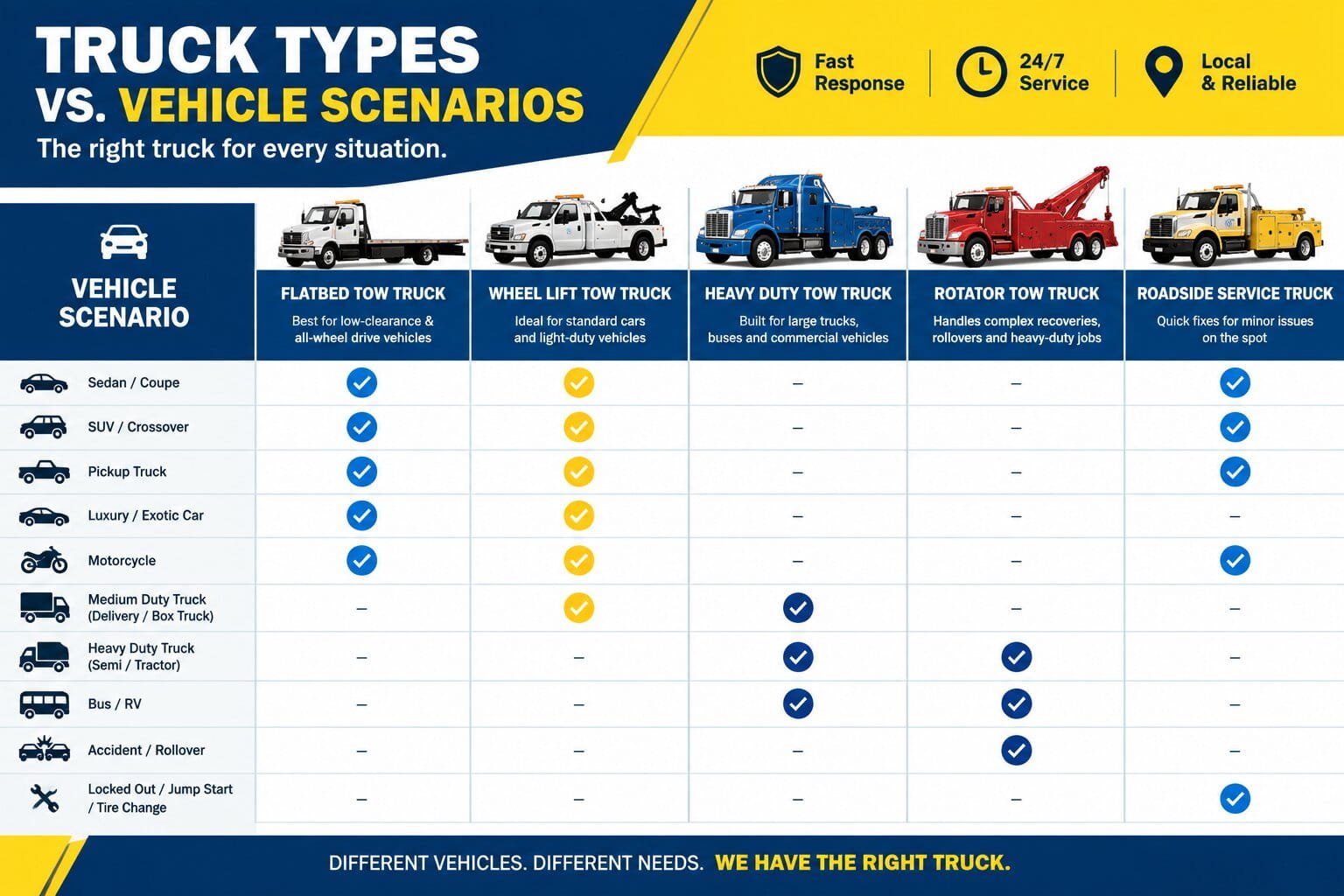
| Situation | Typical Equipment | Why |
|---|---|---|
| FWD sedan, dead battery, no start | Wheel lift or flatbed | Short tow is fine on a wheel lift from the front |
| AWD crossover | Flatbed, or wheel lift plus dollies | Drivetrain must not rotate |
| Electric vehicle | Flatbed | Manufacturer requirement in most cases |
| Underground parking garage | Wheel lift, skates, go-jacks | Clearance and length limits |
| Lowered or exotic car | Flatbed with ramp extensions, soft loops | Approach angle and paint protection |
| Accident with severe damage | Flatbed with winch, possibly boom | Vehicle may not roll |
| Vehicle off the roadway in a ditch | Wrecker with boom, snatch blocks, rigging | Recovery before transport |
| Box truck or RV | Heavy wrecker with underlift | Weight and frame requirements |
| Overturned tractor-trailer | Rotator, air cushions, support units | Lifting, righting, load transfer |
| Motorcycle | Carrier with chock and soft ties | Cannot be secured like a car |
| Construction equipment | Landoll or lowboy trailer | Non-running, low ground clearance, heavy |
How Equipment Affects What You Pay
Towing pricing is generally built from a hook-up or call-out fee plus a per-mile rate, with adjustments for equipment class and conditions. Equipment influences cost in several concrete ways.
Truck class. Light-duty is the base. Medium-duty costs more. Heavy-duty and rotator work is priced in an entirely different tier because of acquisition cost, fuel, insurance, and the specialized certification operators need.
Recovery versus transport. A straightforward hook-and-tow is priced predictably. A winch-out, an upright, or a multi-point recovery is often billed by time and by the number of units on scene.
Additional equipment deployment. Dollies, skates, air cushions, and extra rigging may carry line-item charges because they add setup time and wear.
Scene complexity. Night work, highway closures, hazardous material presence, and multi-truck operations all increase cost.
Storage and secondary handling. If the vehicle goes to an impound or storage yard, daily rates apply separately.
The useful takeaway is that asking for the right equipment upfront usually saves money. A customer who accepts a wheel lift for an AWD vehicle to save a small amount on the tow can end up with a repair bill many multiples larger.
Signs Of An Under-Equipped Or Unprofessional Operator
Watch for these:
- Only one truck type offered regardless of your vehicle. A company with a single wheel-lift truck will try to make every job fit it.
- No questions asked at dispatch. A competent dispatcher asks about drivetrain, clearance, running condition, and location access. Those questions determine which truck is sent.
- Two-point securement on a flatbed. Four independent points is the standard.
- Visibly damaged straps or frayed cable. Cut webbing, deformed hooks, and kinked wire rope are inspection failures, not cosmetic issues.
- Chains around bumpers or suspension arms on a modern car. This causes damage.
- No cones, no lighting, no high-visibility clothing on a live roadway. Scene safety gear is not optional.
- Reluctance to provide written pricing or a company name. Predatory towing exists, particularly around accident scenes.
- No proof of insurance for on-hook coverage. On-hook insurance covers your vehicle while it is being towed. Ask.
Questions Worth Asking Before You Book
- What type of truck are you sending, and why that one for my vehicle?
- Is my vehicle all-wheel drive or electric, and does that change the truck?
- Can your truck physically reach my location — clearance height, gate width, driveway grade?
- Do you carry ramp extensions for low-clearance vehicles?
- How will the vehicle be secured on the deck?
- What is the total estimated cost including hook-up, mileage, and any equipment surcharges?
- Do you carry on-hook and garage-keepers insurance?
- Where will the vehicle be delivered, and can I ride along or meet you there?
A professional will answer all eight without hesitation.
Honest Limitations And Considerations
No equipment category is universally superior, and it is worth being clear about that.
Flatbeds are not always available or appropriate. In dense urban environments, on narrow mountain roads, and in structures with height restrictions, a carrier simply cannot get in. A wheel lift with dollies may be the correct and safe answer.
Rotators are not always necessary. Heavy recovery is expensive, and not every commercial incident needs a rotator. A skilled operator with a conventional wrecker and good rigging resolves many situations more cheaply.
Equipment does not replace operator skill. A poorly rigged pull with excellent equipment is more dangerous than a well-rigged pull with modest equipment. Certification programs and ongoing training exist in this industry for a reason, and experience matters as much as inventory.
Weather and terrain impose hard limits. Soft ground, ice, steep grades, and water all reduce what any truck can safely do. An operator who declines a job or calls for a second unit is often making the correct call, not upselling.
Availability varies enormously by region. Rural areas may have limited heavy recovery coverage, and response times reflect distance more than anything else.
Expert Recommendations
If you are a private vehicle owner: know your drivetrain before you ever need a tow. Write down whether your car is FWD, RWD, AWD, or electric, and check the owner’s manual towing section. It takes five minutes and prevents the most common and most expensive towing mistake.
If you manage a fleet: establish a relationship with a provider before you need one, and verify their heavy-duty capability with your own eyes rather than their website. Negotiate rates in advance, confirm insurance limits, and give them your vehicle specifications so dispatch is faster when it counts.
If you run a dealership or body shop: prioritize providers with wheel-net securement, soft loops, ramp extensions, and photo documentation practices. Transport damage claims are the recurring cost in this relationship, and equipment quality is the variable that controls it.
If you are comparing providers: fleet depth is the most reliable single indicator. A company that owns light-duty carriers, wheel lifts, a medium wrecker, and heavy recovery units can send the right truck. A company with one truck sends that truck to everything.
Frequently Asked Questions
What is the most common type of tow truck?
Flatbed carriers and wheel-lift trucks make up the majority of light-duty work. Flatbeds are favored for longer distances, AWD and electric vehicles, and damaged cars. Wheel lifts dominate short-distance and confined-space work such as parking enforcement.
Can an all-wheel-drive car be towed without a flatbed?
Yes, but only with dollies placed under the wheels remaining on the ground, so that no wheel rotates the drivetrain. A flatbed remains the safer and generally recommended choice.
Do electric vehicles need special towing equipment?
In most cases yes. Most manufacturers specify flatbed transport because the drive wheels should not rotate freely. Operators may also need skates or dollies to reposition a disabled EV before loading.
What is the difference between towing and recovery?
Towing moves a vehicle that is already accessible on a road surface. Recovery involves retrieving a vehicle that has left the road surface, overturned, become stuck, or otherwise requires winching and rigging before it can be towed.
What is a rotator used for?
A rotator is a heavy recovery unit with a boom that rotates 360 degrees. It is used for overturned commercial vehicles, crane-style lifts, steep embankment recoveries, and situations requiring multiple simultaneous pulls.
Why do operators use wheel nets instead of hooks?
Wheel nets secure the vehicle by the tire rather than the frame or suspension. Nothing touches the body, suspension geometry is unaffected during transport, and the risk of bending control arms or damaging paint is eliminated.
Is hook-and-chain towing still legal?
It remains in use, most commonly for salvage and for vehicles without usable wheels. However, it can damage bumpers and unibody structures, so most reputable companies avoid it for driveable consumer vehicles.
Can a tow truck enter an underground parking garage?
A flatbed usually cannot due to height and length. A wheel-lift truck often can, and where even that is impossible, operators use skates and go-jacks to move the vehicle manually to an accessible point.
What equipment is used to tow a motorcycle safely?
A wheel chock to hold the bike upright, soft ties and ratchet straps attached to the frame or triple tree, and a ramp rated for the weight. Motorcycles should never be secured using standard car tie-down methods.
How do operators tow a car with a locked or missing wheel?
Dollies or skates are placed under the affected wheel, or the vehicle is winched directly onto a flatbed deck. A seized brake or missing wheel makes conventional wheel-lift towing unsafe.
What does on-hook insurance cover?
On-hook insurance covers damage to a customer’s vehicle while it is being towed or transported. It is separate from garage-keepers coverage, which applies while the vehicle is in the company’s storage yard.
How much weight can a heavy-duty wrecker handle?
Capacities vary widely by unit. Medium-duty wreckers commonly handle box trucks and RVs, while heavy-duty units and rotators are configured for tractor-trailers, buses, and large equipment. Capacity is determined by the specific truck’s boom, underlift, and chassis ratings rather than by category alone.
Conclusion
The equipment a towing company owns is the clearest available signal of what it can actually do. Flatbeds handle the bulk of modern consumer towing because drivetrains, electric platforms, and low body designs demand it. Wheel lifts remain essential wherever space is tight and speed matters. Integrated units serve high-volume work. Booms and rotators separate towing from true recovery, and heavy wreckers with underlifts carry the commercial side of the industry.
Beneath the trucks sits the equipment that determines whether your vehicle arrives undamaged: winches and rigging chosen for the pull, wheel nets rather than hooks, dollies and skates for immobile vehicles, ramp extensions for low clearance, and the cones, lighting, and absorbents that make a roadside scene survivable.
You do not need to become a technician to use this knowledge. You need to know your own vehicle’s drivetrain, ask which truck is being dispatched and why, confirm that securement will be at four points, and verify insurance coverage. Those four steps place you ahead of the overwhelming majority of customers and dramatically reduce your odds of a bad outcome.
When you call for a tow, the right question is not simply how fast someone can get there. It is whether the truck they are sending is the correct tool for your vehicle and your situation. A professional will welcome that question. That reaction alone tells you most of what you need to know.
 Call us at
  Email us at