“My car got towed” can mean very different things depending on where it happened. A vehicle towed off a private lot and a vehicle towed off a public street go through different processes, involve different authority, and often leave drivers with different next steps. Here’s how the two actually compare.
Table of Contents
ToggleWho Requests the Tow
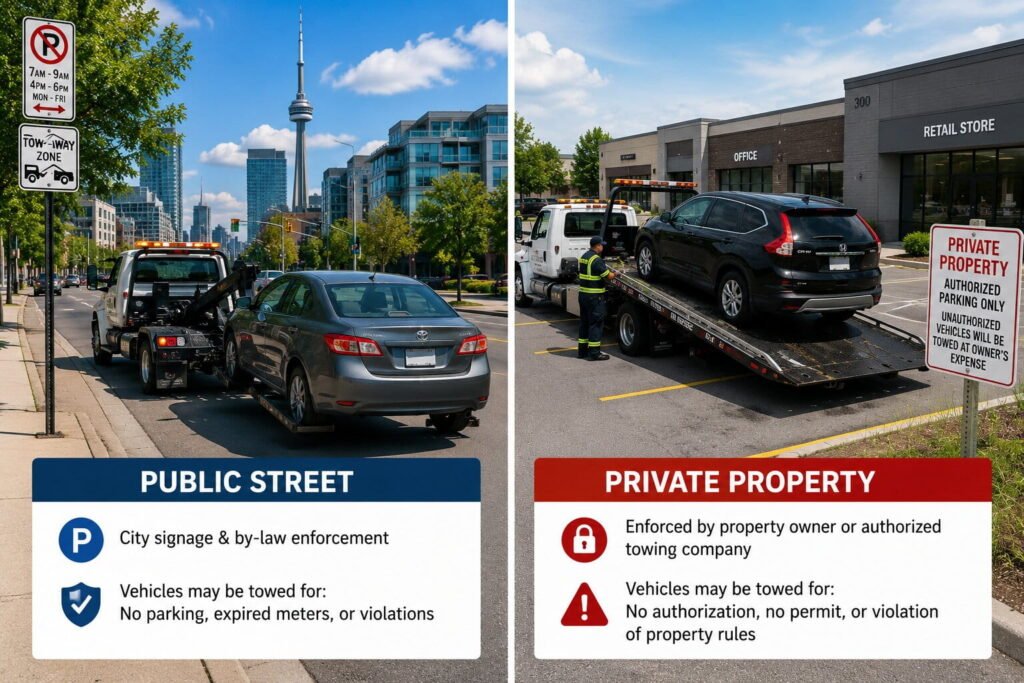
The clearest difference is who initiates it. Private property towing is requested by the property owner or an authorized representative — a landlord, property manager, or business operator dealing with an unauthorized vehicle on their land. Street towing, by contrast, is typically directed by police or municipal parking enforcement, often tied to a parking violation, a traffic obstruction, or a safety concern on a public road.
What Governs Each Process
Both types of towing in Ontario fall under the Towing and Storage Safety and Enforcement Act (TSSEA), which sets certification, rate transparency and consent requirements for the towing companies themselves regardless of where the tow happens. Where they diverge is in the authorization layer above that:
- Private property towing depends on property owner consent, proper signage, and documented authorization
- Street towing depends on municipal parking bylaws, police direction, or a posted no-parking/no-standing restriction on the road itself
Toronto’s own municipal code addresses parking on private and municipal property separately from standard street parking enforcement, which is why the rules can feel like they’re pulling from different playbooks.
Signage Requirements Differ in Practice
On a public street, restrictions are usually posted by the municipality itself — a no-parking sign, a permit-only zone, a fire route marking. On private property, the property owner is responsible for posting their own signage, and that signage is what gives a private tow its legitimacy. A private lot without proper signage is in a much weaker position to justify a tow than a public street with a clearly posted restriction.
What Happens to the Vehicle Afterward
In both cases, the vehicle typically ends up at a licensed storage facility, and the owner has to pay towing and storage fees to retrieve it. The process for disputing a tow differs, though — a street tow tied to a parking bylaw usually has a municipal appeal process, while a disputed private property tow is more likely to come down to whether signage and authorization were actually in place.
Why This Distinction Matters for Property Owners
If you manage a commercial lot, apartment building, or business property, it’s worth being clear with tenants and visitors that your enforcement is private, not municipal — you’re not relying on the city to patrol your lot. Setting up property towing as your own process, separate from any street-level enforcement nearby, means you’re not depending on municipal bylaw officers to handle a problem that’s entirely on your land.
Why This Distinction Matters for Drivers
If your vehicle is missing, figuring out which type of tow happened tells you where to start looking. A vehicle towed from a private lot usually left signage or a contact number behind. A vehicle towed from a public street is more likely to show up through a municipal towing inquiry line or police non-emergency contact, since that process runs through the city rather than a private property owner.
The Bottom Line
Private property towing and street towing both remove a vehicle, and both fall under the same provincial certification framework — but the authority behind each is different. One comes from the property owner, the other from municipal or police direction. Knowing which situation you’re in changes what you do next, whether you’re the one requesting the tow or the one trying to find your car.
FAQs
Who can order a tow from a public street in Toronto?
Street towing is typically directed by police or municipal parking enforcement, tied to a parking bylaw violation or a safety/traffic obstruction.
Does the same law apply to both private and street towing?
The towing companies themselves are regulated under the same provincial framework, the Towing and Storage Safety and Enforcement Act, but the authorization for the tow itself comes from different sources depending on where it happens.
Is signage handled differently for private lots versus streets?
Yes. Municipal signage on public streets is posted by the city, while signage on private property is the property owner’s responsibility and is central to whether a private tow is considered valid.
How do I find my car if I’m not sure which type of tow happened?
Check the property for signage or a contact number if it was likely a private lot, or contact a municipal towing inquiry line or police non-emergency line if it looks like a street-related tow.
Can a property owner tow a car parked illegally on the street next to their property?
No — a property owner’s authority to request a tow generally applies to their own private property, not to public street parking, which is handled through municipal enforcement.
 Call us at
  Email us at