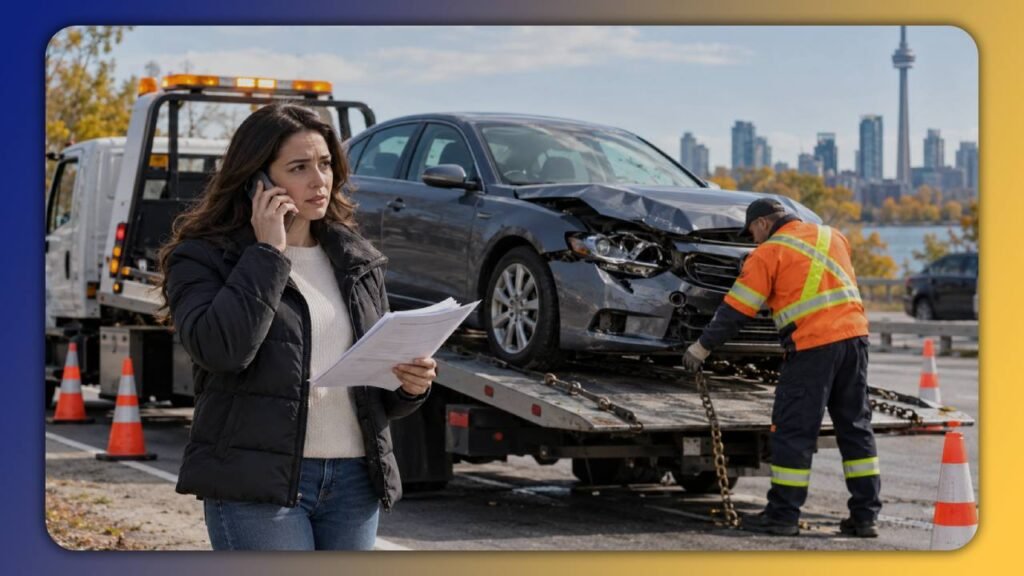
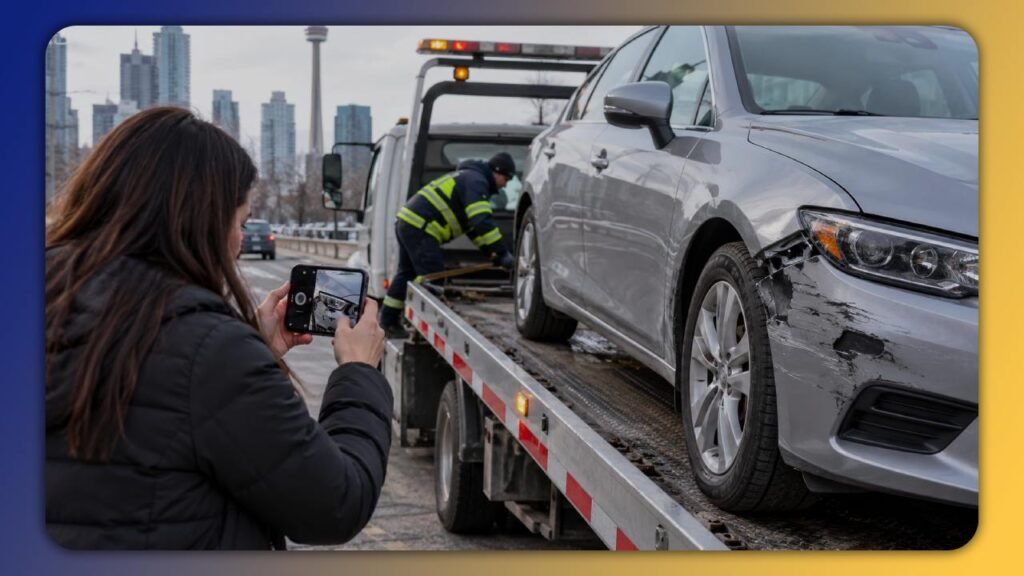
If a tow truck damages your car in Ontario, photograph the damage, contact the operator, and notify your insurer promptly. Preserve the tow paperwork and request a written repair estimate before agreeing to a settlement.
You can seek compensation when evidence shows the towing operator caused the damage. Ontario’s towing complaint process examines regulatory conduct, but the ministry cannot award your repair costs. Start with safety, evidence, and written communication.
If a tow truck damages your car, make an incident timeline while details remain fresh.
Table of Contents
ToggleTow Truck Damages Your Car During an Ontario Tow
A tow truck damages your car through loading, towing, unloading, or poor vehicle handling. A new scratch alone does not prove who caused it. Compare your vehicle’s condition before pickup and after delivery. Clear photographs and a dated timeline make that comparison stronger.
Record the delivery address, driver’s name, tow truck identification, and vehicle condition immediately. Ask the operator to record your concern on the delivery paperwork. Keep your original files rather than sending your only copies.
If a tow truck damages your car, identify the exact location of each new mark.
When a tow truck damages your car, request both pickup and drop-off photographs from the operator.
Damage Discovered at the Drop-Off Location
Photograph new marks before anyone moves or repairs your vehicle. Capture the bumper, wheels, doors, and underneath accessible bodywork. Photograph the full car beside the delivery location. Ask a witness to describe what the witness actually observed.
Damage Discovered After You Leave
Record when you first noticed the issue and where the car remained overnight. Save parking footage, security camera recordings, and earlier photographs. Contact the storage yard quickly because surveillance recordings do not remain available indefinitely.
Immediate Safety Checks After Towing Damage
Stop driving when towing damage affects steering, brakes, tyres, or a wheel assembly. Book an inspection before driving a vehicle with new fluid leaks or warning lights. Call emergency services for immediate danger, including smoke or an unsafe roadside position.
Inspect your vehicle from a safe location. Avoid entering traffic or climbing underneath an unsupported car. Arrange another tow when a technician identifies a mechanical safety concern.
If a tow truck damages your car mechanically, do not drive until a qualified technician checks safety.
Steering, Tyres and Suspension Checks
Look for a tilted wheel, leaking shock absorber, or damaged tyre sidewall. A sidewall cut measuring 1 inch (2.5 cm) deserves professional inspection, not roadside patching. Do not test-drive a car with binding steering or a visibly displaced wheel.
Fluid Leaks and Underbody Damage
Check the ground for new oil, coolant, or transmission-fluid stains. Photograph any visible impact near the underside. Tell the repair shop whether the vehicle scraped while the driver loaded or unloaded it.
Passenger and Roadside Safety
Keep passengers away from operating winches and loading ramps. Stand at least 10 feet (3 metres) clear when conditions permit. Follow the driver’s safety instructions and stay behind a suitable roadside barrier when available.
Evidence That Supports a Vehicle Damage Claim
Collect 4 evidence groups: vehicle photographs, towing records, witness details, and independent repair findings. Your evidence should show the vehicle’s condition and connect the damage to a particular event. Avoid claiming a definite cause before a mechanic checks the affected part.
Document each observation separately from your interpretation.
When a tow truck damages your car, precise time stamps can connect loading actions with later findings. Photographs can show a bent bracket; a mechanic can explain the damage mechanism.
Before-and-After Vehicle Photographs
Retrieve photographs from your phone, dashcam, insurer, repair shop, or previous sales listing. Match the same bumper edge, wheel arch, or door panel. Avoid filters or editing that obscure marks.
Towing Documents and Operator Identity
Save the consent form, invoice, payment receipt, destination details, and operator certificate information. Ontario tow trucks must display operator identification and certificate details. Record the company’s legal name rather than relying on a driver’s first name.
Witnesses and Video Footage
Request footage from a workshop camera, driveway camera, or shop entrance. Ask witnesses for an account in their own words. Record exact times and locations, including the pickup and delivery addresses.
Tow Truck Damages Your Car and Operator Responsibility
Ontario requires tow operators to take precautions against loss or damage to vehicles during towing. The Towing and Storage Safety and Enforcement Act, 2021 (TSSEA) also sets operator conduct and recordkeeping duties. A regulatory breach does not automatically establish a particular repair payment.
A tow truck damages your car claim generally turns on care, causation, and financial loss. You need evidence connecting the operator’s conduct with the claimed repair. Fault depends on the surrounding facts, including pre-existing accident damage.
If a tow truck damages your car, required insurance coverage alone does not prove legal responsibility.
Ontario Towing Certificates and Insurance
Ontario tow operators must carry prescribed liability insurance. Current rules specify at least $100,000 for damage to vehicles in their care, custody, or control. That is an operator coverage requirement, not a guaranteed payment to every claimant.
Existing Damage Versus New Damage
Separate collision damage from additional towing damage. A vehicle can arrive with a cracked bumper before a tow begins. A fresh wheel scrape after unloading raises another question. Obtain dated evidence for each condition.
Driver-Requested and Police-Directed Tows
Ontario generally requires your consent before a voluntary tow. A police-directed tow follows different authorization rules. Neither situation removes the operator’s duty to handle the vehicle with reasonable care. Keep the police occurrence number for a directed recovery.
Common Loading and Transport Damage
Towing-related damage often affects bumper edges, body panels, wheels, or mechanical components. Damage patterns differ between wheel-lift towing and flatbed transport. A technician should distinguish new impact marks from ordinary wear or collision damage.
When a tow truck damages your car, ask the mechanic to record the suspected impact location.
Scratches, Dents and Bumper Damage
Loading angles can put low bumpers close to a ramp. Incorrect hook placement can mark suspension or body components. Photograph the exact contact area. Request a written estimate identifying labour, parts, and paint work.
Drivetrain and Transmission Concerns
Some all-wheel-drive vehicles require specific towing procedures. The owner’s manual identifies manufacturer-approved methods. Ask a technician to review unexpected drivetrain noises after a tow. Do not infer transmission failure from a warning light alone.
If a tow truck damages your car during wheel-lift towing, document any new drivetrain symptoms.
Flatbed Loading and Tie-Down Marks
A flatbed raises all vehicle wheels off the road during transport. Proper loading still requires approved tie-down points and clearance checks. Review professional flatbed towing options when arranging transport for low-clearance vehicles.
How to Report Towing Damage to the Operator
To report towing damage to the operator, send a written notice with photographs, the tow date, and the specific damage. Request an acknowledgment and ask who handles vehicle damage claims. Keep the tone factual, even when the incident feels upsetting.
Call first when you need urgent instructions, then confirm the discussion in writing. Ask the operator to preserve truck camera footage, dispatch records, and vehicle condition photographs. Do not assume a verbal promise resolves your claim.
If a tow truck damages your car, written updates make future conversations easier to verify.
Written Notice and Claim Details
Include your name, plate, Vehicle Identification Number (VIN), tow date, route, and contact information. Describe the defect without guessing. Attach copies of the invoice and photographs. State whether the vehicle remains unsafe to drive.
Repair Estimates and Written Responses
Obtain a qualified shop’s itemized assessment. Ask the operator to identify the insurer or claims contact handling your report. Do not agree to a final payment before understanding the complete repair scope. Preserve receipts for necessary inspections and transport.
When a tow truck damages your car, send identical evidence copies to each claims contact.
A Clear Damage Report Example
You can write: “My vehicle arrived on 20 October with a new rear bumper scrape. Please review the attached photographs and invoice.” Add your requested next step and a reasonable reply date. Keep the full email thread for later review.
Insurance Coverage for Towing-Related Damage
Notify your own insurer promptly, even when you plan to ask the tow operator for compensation. Explain that a towing incident caused the newly discovered concern. Your policy and insurer determine the applicable coverage, deductible, and claim process.
An insurer may request photographs, a condition report, and an independent estimate. Your own insurer may address covered repairs before resolving responsibility with another party. Do not assume direct compensation property damage covers every towing incident.
When a tow truck damages your car, discuss collision coverage and exclusions with your insurer.
Contacting Your Own Claims Adjuster
Give your insurer the tow operator’s name, contact details, and incident timeline. Ask whether the insurer wants an inspection before repairs begin. Explain any urgent safety-related work already completed. Keep the adjuster’s file number.
Requesting Operator Insurance Information
Ask the towing company which person manages liability or vehicle-in-custody claims. Record the claims contact and any reference number. Operator coverage limits alone cannot establish whether the insurer accepts your claim. Provide documents rather than predictions.
Deductibles and Temporary Transport Costs
Ask your adjuster which expenses your policy covers. Keep rental vehicle, inspection, and replacement tow receipts when necessary. Confirm decisions in writing.
If a tow truck damages your car, keep track of any deductible discussions and insurer decisions.
Ontario Complaints and Legal Recovery Options
File a Ministry of Transportation complaint for relevant towing conduct, including certificate concerns or consumer-protection breaches. The ministry can investigate compliance and take regulatory action. The ministry cannot order payment for vehicle repairs through its complaint portal.
If a tow truck damages your car, choose a compensation route separately from regulatory reporting.
For financial recovery, first seek a documented resolution with the operator or insurer. Ontario Small Claims Court hears eligible monetary claims up to $50,000. The threshold took effect on 1 October 2025.
Ministry of Transportation Complaint Process
Use Ontario’s towing complaint portal for conduct issues, including improper consent or unsafe practices. Supply names, dates, invoices, photographs, and the certificate number. Describe exactly what happened. Explain whether the operator already responded.
Small Claims Court and Time Limits
Review filing requirements before starting a court claim. Ontario generally applies a 2-year basic limitation period from discovery, subject to exceptions. Court claims require the correct defendant and reliable evidence. Seek Ontario legal advice about your own deadline.
Insurance Complaint Escalation
Start with your insurer’s complaint officer when you disagree with an insurance decision. Request the insurer’s final position and external review options. The Financial Services Regulatory Authority of Ontario (FSRA) describes the complaint route. Distinguish insurer complaints from complaints about tow operator conduct.
Repair Estimates and Settlement Documentation
Request an itemized repair assessment before accepting a settlement. A credible estimate explains which components need repair or replacement. Compare the estimate with photographs, the incident timeline, and any insurer inspection.
When a tow truck damages your car, identify which repairs directly address the alleged towing damage.
Choose an independent mechanic or body shop qualified for the suspected damage. For complex damage, ask whether diagnosis requires disassembly. Obtain approval when your insurer requires an inspection before non-emergency work.
Separate Costs and Repair Evidence
Keep separate entries for diagnosis, parts, labour, paint work, and safety-related transport. Do not add speculative compensation amounts without supporting proof. Calculate actual losses using documented figures.
Settlement Agreements and Release Forms
Read any release before signing. A settlement can restrict later claims concerning the same damage. Ask for clarification before accepting a final amount. Seek legal advice when the release language exceeds the disputed repair.
Vehicle Damage Claims Quick-Reference Checklist
Use the checklist to organize actions, timing, methods, and difficulty. The timing describes practical priorities, not universal legal deadlines. Insurance contracts and individual circumstances can require faster action.
| Task | Timing | Method |
Difficulty |
| Photograph vehicle | Immediately | Wide and close-up images | Easy |
| Preserve tow paperwork | Same day | Consent, invoice, operator ID | Easy |
| Notify operator | Promptly | Written report and photos | Easy |
| Notify insurer | Promptly | Claim number and records | Moderate |
| Obtain repair assessment | Before non-urgent repair | Itemized mechanic estimate | Moderate |
| Escalate unresolved claim | After written review | Regulator, insurer or court | Advanced |
When a tow truck damages your car, retain a complete case file. Name folders by date and include original photographs. Save copies outside your phone. A clear record helps insurers and repair professionals follow the claim.
If a tow truck damages your car, dated responses help explain unresolved disagreements.
Preventing Damage During Future Towing
Choose a certified operator and confirm the towing method before pickup. Check the operator’s company details, intended destination, and maximum rate schedule. Photograph your vehicle before loading. Keep the consent document and itemized invoice.
When a tow truck damages your car, an earlier condition report can protect your evidence.
For damaged or immobile vehicles, ask about local accident recovery arrangements. Describe locked wheels, low clearance, or broken suspension before dispatch. Appropriate equipment selection reduces avoidable handling problems.
Matching Equipment to the Vehicle
Tell the operator whether your car uses all-wheel drive, lowered suspension, or an electric drivetrain. Share the owner’s manual towing instructions. Identify restrictions before the driver attaches equipment. Ask about dollies or a flatbed when appropriate.
Recording Condition Before Loading
Photograph all 4 corners, both sides, and the dashboard warning lights. Record pre-existing dents and damaged tires. Ask the driver to note existing defects. Retain the digital originals after the tow finishes.
Checking the Vehicle After Delivery
Walk around the car before signing any condition acknowledgment. Compare visible panels with pre-pickup photographs. Note concerns immediately without making unsupported accusations. Request a safe drop-off and a copy of the invoice.
Frequently Asked Questions
Can you claim compensation when a tow truck damages your car?
Yes. You can pursue compensation for provable damage connected to negligent or otherwise legally responsible towing conduct. Liability depends on the evidence and applicable law.
Does the Ontario towing complaints portal pay repair costs?
No. The ministry investigates specified operator conduct and certificate concerns. Financial compensation requires a separate agreement, an insurance claim, or legal action.
Should you contact your insurer after towing damage?
Yes. Notify your insurer promptly and ask how your coverage applies. Give your adjuster the towing invoice and evidence file.
Can you file a Small Claims Court case for towing damage?
Yes. Ontario Small Claims Court handles eligible claims up to $50,000. Confirm the correct defendant, evidence, filing rules, and limitation period first.
Should you repair a damaged car before documenting the damage?
No. When safe, photograph the damage and arrange an inspection first. Complete urgent safety work when necessary and retain every receipt.
Safe Vehicle Transport Across the GTA
When a tow truck damages your car, document the loss, report the concern, and preserve your records. Proper evidence supports a fair review without premature assumptions about liability. For a separate vehicle recovery, request accident towing support from GTA Towing & Roadside Assistance. Share your vehicle condition and destination before booking.
 Call us at
 Email us at