
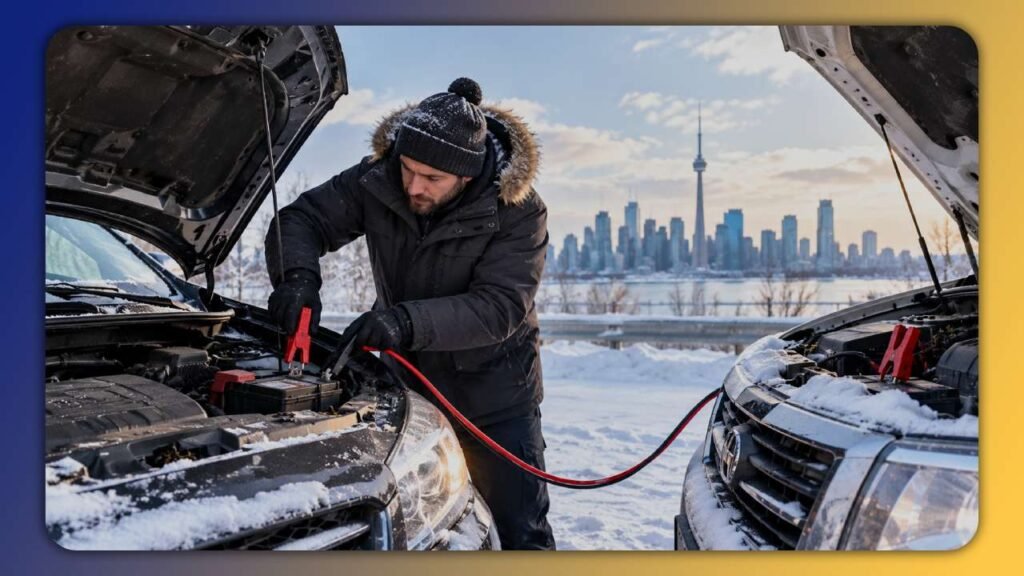
You can jump start a car in cold weather using approved 12-volt jumper cables or a compatible portable booster. First, check the battery, follow your vehicle manual, and stop if the battery looks frozen or damaged.
Table of Contents
ToggleJump Start a Car in Canadian Winter Conditions
You can jump start a car during winter when the battery and vehicle meet safety checks. When you jump start a car, remember that cold reduces available cranking performance. Cold engine oil also increases the starter motor’s workload. Both problems often appear after overnight parking.
Watch for slow cranking, rapid clicking, dim headlights, or a dark dashboard. A single click can also signal a starter fault. Bright lights with no starter response deserve further diagnosis. Check whether the symptoms match a discharged battery before connecting any cables.
Confirming a Flat 12-Volt Battery
Check the dashboard before opening the hood. Interior lights that fade during cranking support a low-battery diagnosis. A battery tester can confirm low state of charge and starting performance. A mechanic can separate battery, charging-system, and starter-motor faults.
Choosing a Safe Place for a Boost
Move occupants away from moving traffic before opening the hood. Choose level ground with stable footing, including a driveway or designated parking area. Set each parking brake and select Park or Neutral as applicable. Never work beside active highway lanes.
Call emergency services if your location presents an immediate danger. Ask for roadside help instead of trying to jump start a car on an unsafe shoulder. Keep warm clothing accessible while waiting. Avoid running an engine inside a closed garage because exhaust gases create a poisoning risk.
Cold Weather Battery Failure and Starting Problems
Cold reduces the battery’s ability to deliver starting current. At the same time, a cold engine demands more power. A battery that started reliably in autumn can struggle during a winter cold snap. When you jump start a car, you provide temporary assistance rather than repair the battery.
Battery Charge Versus Battery Health
Distinguish low charge from permanent battery failure before choosing a boost. An interior light left on overnight can discharge a healthy battery. Old plates inside a lead-acid battery can also lose capacity permanently. A load test helps reveal failing battery performance.
Check the alternator if the battery keeps losing charge. A broken drive belt or charging fault can stop replenishment. Watch for an illuminated battery warning lamp after starting. Ask a technician to test the charging voltage and battery condition.
Warning Signs Beyond the Battery
Listen to the engine during one brief starting attempt. Normal cranking without ignition suggests fuel, ignition, or engine-management trouble. A silent start can involve the starter circuit or transmission safety switch. Stop repeated attempts after abnormal noises or burning smells.
Essential Equipment for a Safe Battery Boost
Prepare approved jumper cables, eye protection, insulated gloves, and a working 12-volt power source. You also need the vehicle owner’s manual. The manual shows where to jump start a car and lists model-specific restrictions. Never substitute guesswork for the printed vehicle procedure.
Jumper Cable and Donor Checks
Select cables with intact insulation and clean clamps. Longer cables help keep vehicles apart, but excessively thin cables lose useful current. A set around 12 feet (3.7 metres) offers practical reach for many layouts. Check the cable maker’s rating for your engine.
Use a conventional donor vehicle only when both manuals permit the connection. Match 12-volt systems and keep the vehicles from touching. Never jump start a car using an electric or hybrid donor without explicit approval. Their 12-volt electrical systems can have specific restrictions.
Personal Protection in Freezing Weather
Wear safety glasses and gloves before handling battery connections. Remove rings, watches, and loose jewellery. Keep metal tools away from both battery posts. Route the leads away from engine fans and drive belts, including electric cooling fans.
How to Jump Start a Car With Jumper Cables
To jump start a car with jumper cables, follow the owner’s manual and use four connections in the approved order. You jump start a car using the sequence below only on an approved negative-ground 12-volt vehicle. Manufacturer-designated remote terminals take precedence over exposed battery posts.
Positioning the Donor Vehicle
Park the donor close enough for the cables to reach without tension. Leave at least 6 inches (15 centimetres) between the vehicle bodies. Turn off both ignitions and electrical accessories. Apply both parking brakes and check the cables for cuts.
Identify the positive post marked + on each permitted connection point. Find the negative donor terminal marked –. Locate the stalled vehicle’s approved chassis ground. Do not attach a clamp to painted trim, fuel lines, or the wrong metal bracket.
Connecting Red and Black Clamps
Follow these four connections for an approved conventional setup:
- Attach the first red clamp to the stalled vehicle’s positive connection point.
- Attach the second red clamp to the donor battery’s positive terminal.
- Attach the first black clamp to the donor battery’s negative terminal.
- Attach the final black clamp to the stalled vehicle’s designated ground, away from the battery.
Before you jump start a car, check every clamp for a secure grip. Keep the remaining metal clamps separate throughout the process. The final ground connection helps place possible sparks away from battery gas. Use the manufacturer’s specified ground location whenever available.
Starting and Disconnecting Both Vehicles
Start the donor engine only when the donor manual allows running during boosting. Wait approximately 3 to 5 minutes, then make one brief starting attempt. Limit cranking to about 5 seconds per attempt unless your manual specifies otherwise. Stop after 2 or 3 unsuccessful attempts and seek diagnosis.
When the stalled engine starts, follow both manuals before removing the cables. For the conventional sequence, remove the stalled vehicle’s ground clamp first. Next remove donor black, donor red, and stalled red. Keep every clamp clear of belts and moving fans.
How to Jump Start a Car With a Portable Booster
To jump start a car with a portable booster, follow the pack’s instructions and your vehicle’s approved jump points. You can jump start a car without another vehicle when a compatible portable pack works. Portable lithium units still require adequate charge and safe operating temperatures.
Choosing a Compatible Booster Pack
Read the booster label for 12-volt compatibility and suitable engine capacity. Choose a unit with reverse-polarity protection and a clear status display. Do not assume the largest advertised peak amperage proves reliable performance. Check the maker’s cold-weather operating limits.
Store the pack within its recommended temperature range. Bring a cold-soaked booster to an approved operating temperature before use. Never warm a lithium pack with an open flame or heater. Follow the pack maker’s storage and charging instructions.
Connecting and Using the Booster
Switch off the vehicle and confirm the booster is off. Connect the positive clamp to the approved positive point. Connect the negative clamp to the approved ground point. Place the pack on a stable surface away from moving engine parts.
Activate the pack exactly as its manufacturer instructs. Try one brief start while observing the device display. Disconnect the pack in its required order after the engine starts. Stop trying to jump start a car if the booster reports polarity errors, overheating, or connection faults.
Frozen Batteries and Unsafe Jump-Start Conditions
Never jump start a car with a battery that has frozen, leaked, cracked, or swollen. Freezing creates a battery explosion hazard during charging or boosting. A severely discharged lead-acid battery can freeze around 0°C (32°F). Outside temperature alone cannot confirm whether you can jump start a car safely.
Visible Damage and Freeze Indicators
Check for a distorted case, ice, wetness, or damaged terminals. Do not open battery caps to inspect frozen electrolyte. Never charge or jump-start a suspected frozen battery. Arrange professional inspection and replacement where the manufacturer requires it.
Stop when you smell sulfur, see smoke, or notice strong heat. Keep people away from the engine compartment. Call emergency services if a fire starts. Avoid pouring hot water onto a battery or heating the case directly.
Roadside Conditions That Require Assistance
Do not jump start a car while traffic passes close to your work area. Ice, poor visibility, and blowing snow can make clamp placement unsafe. Contact a dispatcher and explain the exact road position. Move to a protected location only when you can do so safely.
GTA Towing & Roadside Assistance advertises professional battery boosting across its listed service area. Call +1 (437) 460-6320 for an individual assessment. Ask the dispatcher for the current arrival estimate and quotation. No fixed battery-boost price appears on that service page.
Hybrid, Electric, and Start-Stop Vehicle Precautions
Check your model’s owner manual before working on any hybrid or electric vehicle. Many models have a 12-volt auxiliary battery and a separate high-voltage traction battery. Ordinary jumper leads never connect to orange high-voltage cables. Some vehicles provide special remote boosting points.
Hybrid and Electric Vehicle Limits
A Toyota hybrid can accept a specific 12-volt boost when its owner manual permits the procedure. The same Toyota instructions forbid certain hybrid models as donors when you jump start a car. Treat both directions as separate permissions. Do not use any hybrid or electric donor without explicit manufacturer approval.
Automatic Start-Stop Systems
Start-stop vehicles often use enhanced flooded batteries (EFB) or absorbent glass mat (AGM) batteries. A normal-looking battery can require vehicle-specific monitoring and charging procedures. Follow the manufacturer’s remote terminal instructions when fitted. Do not guess battery type from the case colour.
Arrange battery coding or registration if your model requires it after replacement. Incorrect replacement specifications can affect charging behaviour. A technician can verify battery technology, capacity, and electronic registration needs. Check the vehicle handbook before buying replacement equipment.
Common Jump-Starting Errors and Battery Damage
Reversed Clamps and Sparks
Never connect red to negative or black to positive unless a manufacturer describes a special marked connection. A polarity mistake can harm electronics and create strong sparks. Do not touch opposing clamp jaws together while a cable remains connected. Stop and request professional help after accidental reversed connection.
Repeated Cranking and Short Driving
When you jump start a car, avoid repeated cranking of a reluctant starter. Repeated attempts can overheat the starter motor and discharge the donor source. After you jump start a car, another start is not guaranteed. A short drive often cannot restore a deeply depleted battery.
Arrange a proper battery charge and test. Use a charger approved for the battery type. An alternator restores power during normal driving, but it cannot confirm battery health. Investigate recurring discharge before the next cold morning.
Battery Charging and Testing After a Successful Start
After you jump start a car, check the charging system and battery before relying on another journey. After you jump start a car, running normally only confirms a temporary recovery. Battery age, poor connections, and alternator faults still need attention.
Driving After the Engine Restarts
Follow the manual’s post-boost guidance and drive only when the vehicle remains safe. A 20 to 30 minute drive can add charge, but driving time never guarantees full recovery. Avoid switching the engine off in an isolated location before checking restarting reliability.
Watch the battery warning lamp and dashboard voltage alerts. Stop safely if the engine stalls or electrical systems fail. Ask a garage to conduct a charging-system test. Replace the battery only when testing supports the decision.
Planning a Winter Battery Test
Schedule testing before frequent freezing nights. Canadian Automobile Association (CAA) recommends checking older batteries and visible warning signs. After you jump start a car, request a battery and charging-system inspection. A written result helps you compare options without guessing.
Winter Breakdowns Across Toronto and the GTA
Cold conditions can strand you across the Greater Toronto Area (GTA), including home, work, or roadside parking areas. Tell the dispatcher your exact location and vehicle model. Explain whether the engine clicks, cranks slowly, or stays silent. Mention suspected battery damage before anyone attempts a boost.
Preparing a Clear Assistance Request
Provide the street address, closest intersection, and safe access instructions. Name your vehicle’s make, model, and year. Explain any hybrid or electric powertrain. Tell the team about smoke, leaks, or dashboard warnings immediately.
For winter help, review round the clock roadside assistance and confirm current availability. The website lists battery boosting among its roadside services. Ask for a service quote before dispatch. Do not assume a tow is necessary before a technician checks the vehicle.
Escalating From Battery Boost to Towing
Review reliable local car towing when the vehicle cannot start safely. Ask the company to confirm pickup, destination, and current charges. Keep your keys and repair information accessible. Never drive an unsafe car simply because the engine restarts.
Winter Jump-Start Quick-Reference Checklist
Use the checklist before you jump start a car to identify unsafe battery conditions. The times describe approximate task duration, not an arrival promise. Follow manufacturer guidance when a model needs different steps.
| Task | Timing | Method |
Difficulty |
| Check location safety | Before opening hood | Move clear of traffic; secure vehicle | Easy |
| Inspect battery | 1–2 minutes | Look for leaks, swelling, freezing | Easy |
| Read manual points | 2–5 minutes | Find approved 12-volt terminals | Moderate |
| Attach jumper leads | 2–4 minutes | Red, red, black, approved ground | Moderate |
| Attempt controlled start | 3–5 minutes preparation | Brief cranking; stop after repeated failure | Moderate |
| Remove cables | 1–2 minutes | Reverse approved connection order | Moderate |
| Arrange battery testing | After safe restart | Battery and alternator checks | Easy |
Frequently Asked Questions
Can you jump start a car below freezing?
Yes. A healthy, unfrozen 12-volt battery can accept an approved boost below freezing. Never boost a frozen or damaged battery.
Can you jump start a car with a hybrid vehicle?
Not automatically. Use a hybrid as a donor only when its manufacturer explicitly allows it. Never connect jumper cables to high-voltage components.
Does a 30-minute drive fully recharge a flat battery?
No. Driving adds charge but does not guarantee complete recovery. Use the correct charger and arrange a battery test.
Can a dead car battery freeze near 0°C (32°F)?
Yes. A severely discharged lead-acid battery can freeze near 0°C (32°F). Stop and seek professional inspection when freezing seems possible.
Should you keep trying when the car will not start?
No. Stop after the manufacturer’s recommended attempts. Repeated cranking risks overheating and hides other mechanical faults.
Professional Battery Boost Support in Toronto
A safe winter boost starts with your owner’s manual, battery inspection, and correct 12-volt connections. Stop for freezing, damage, unsafe traffic, or an unsupported vehicle configuration. GTA Towing & Roadside Assistance provides battery boost and roadside support across the GTA. Request professional battery boost service for a location-specific quote and practical roadside support.
 Call us at
 Email us at